
Professional services
A scoped threat model of one system, one service or your whole environment, with a report, a debrief for your technical and executive teams, and a prioritised roadmap.
Scope a threat model THREAT MODELLING
We map your most important systems against the way real attackers operate, then show you which controls would stop them and which gaps to close first. Risk you can explain to your board, and a plan your engineers can act on.
Boards ask what could actually happen to the organisation. Most security programs answer with a list of controls and a compliance score. Budget goes to the next tool rather than the threat most likely to cause harm, and nobody can say with confidence whether the SOC would see a real attack in progress.
We combine two proven frameworks. NIST risk management gives the strategic view: what matters most to your organisation, how likely each threat is and what it would cost you. MITRE ATT&CK, the global knowledge base of real adversary tactics and techniques, gives the tactical view: how an attacker would get in, move through your environment and reach what matters. Together they turn an abstract risk register into an evidence-based defence plan.
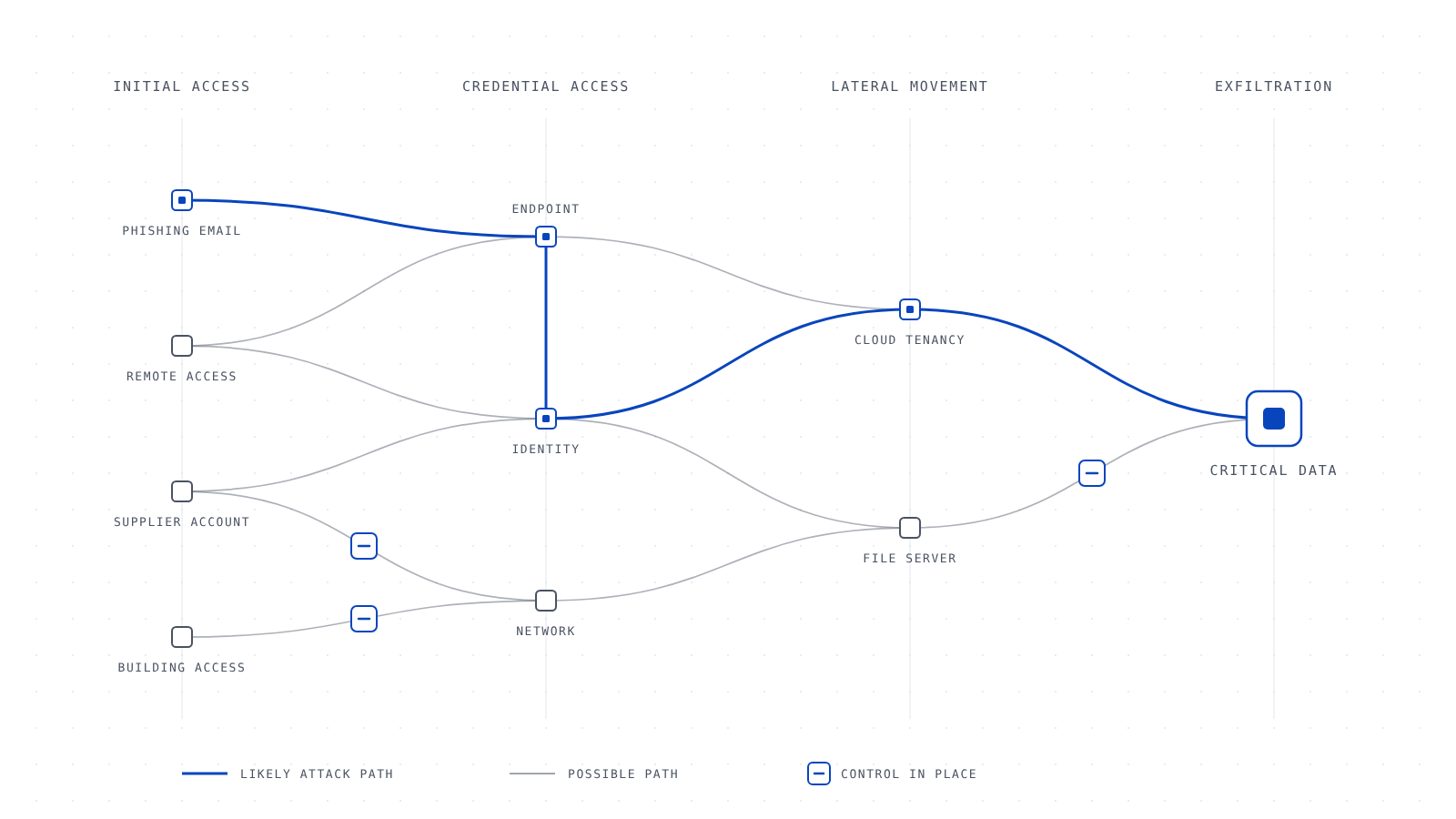
Each path is mapped to MITRE ATT&CK tactics, then tested against your controls and your SOC's detection.
Stopped / DetectedGap to close
Illustrative example. Physical entry points are modelled with Nueva Secure.
A scoped threat model of one system, one service or your whole environment, with a report, a debrief for your technical and executive teams, and a prioritised roadmap.
Scope a threat modelKept current as your environment and the threat landscape change, reviewed after major change, and used to tune SOC detections and target penetration testing.
Talk about an ongoing programRecommended frequency: before you build or buy any significant system, then at least once a year and after major change.
A risk assessment tells you which risks matter. Threat modelling shows how each one would actually happen, step by step, so you know exactly which controls and detections stop it. We do both together.
A threat model works out where an attacker would go and why. A penetration test proves whether they can get there. Modelling first makes testing sharper; testing afterwards proves the fixes hold.
Ideally at design stage, before a system goes live, when changes cost least. It's equally valuable for existing critical services, and after a major change, an acquisition or an incident.
Time with the people who know the systems, any architecture and data-flow documentation you have, and a clear view of what matters most to the business. We fill the gaps in workshops.
Yes. We use MITRE ATLAS, the companion framework to ATT&CK for AI, to model risks such as prompt injection, data leakage and agent misuse.
Start with a conversation about what matters most to your organisation.
Call our incident team any time. If we can't answer straight away, leave a message and a responder will call you back as soon as possible.